
Wool sacks filled with fleece and in the background the shorn sheep
The rain has finally stopped and I have been out shearing. The first day I did three Southdowns, the second day I did five Southdowns and the third day I managed six Southdowns. Then over the weekend I broke the ten barrier, shearing 12 Mules in one day. These are tiny numbers compared to professional shearers but it’s my personal battle and each time I do more I get a real buzz.
The advantage of Southdowns is they are quite small sheep so I found them easy enough to turn and get out of the pen now that I am getting fitter – I wouldn’t have found it easy a few weeks ago! The disadvantage is they have wool growing in every conceivable nook and cranny. These Southdowns were short and chubby, little barrels on legs. Fat sheep are easier to shear, there are less lumps and bumps. You can read more about shearing Southdowns here.
While moving the Southdowns I put my hand on a ram’s back to push him, as I did so there was a terrible sound of crunching bones. My stomach turned over. ‘I’ve broken his spine.’ I thought, which was crazy because I hadn’t pushed him very hard. ‘What was that?’ I asked. ‘His teeth.’ The shearer said. His teeth? The sound came again, I could see the ram was grinding his teeth. He must have happened to grind them just as I pushed him.
When we switched to shearing North of England Mules the sheep felt completely different. Mules are tall elegant sheep with long bodies, long necks and long legs, unlike the short necked Southdowns.
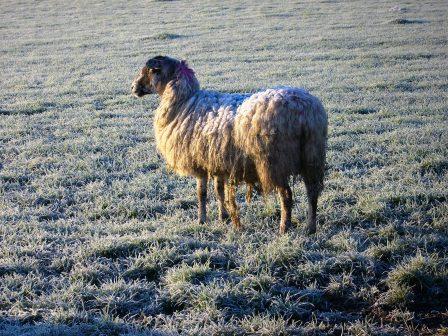
A North of England Mule ewe
The squat Southdowns always felt stiff between my legs and when sat up they tended to keep their heads up. The Mules felt much more floppy and hung their heads when sat up. Except for one sheep whose head was hanging down relaxed then she suddenly threw her head in the air and smacked me in the face – ouch.
When I had the Southdowns sat between my legs their shoulders came to my knees but the Mules seemed to fill the space between my legs so I felt that if the sheep pushed against me I would take off. The Mules were also more bony, their hip bones protruded and on some the back bone was prominent. This meant I was shearing up and down hill, trying not to leave wool in the hollows. The sheep weren’t in bad condition, it’s just different breeds have different body shapes and these sheep were still feeding their lambs so they were on the slim side.
At the Mule job I started using a Warrie Back Aid. You can see the Back Aid in this picture. Isn’t it a beautiful setting?

I haven’t used one before as I thought it was another piece of equipment to master and I had enough to think about. However the Back Aid didn’t get in my way or restrict me at all as I had feared. A Back Aid is a gadget which takes some of your weight while you are bent over shearing, it eases the strain on the back. The Back Aid is basically a wide sheep skin strap suspended on springs, the springs allow plenty of flexibility, as I found out. Unfortunately, the chestbelt sits across the chest under the arms, for me that means right across the bosom. I thought this would be uncomfortable but actually it wasn’t and I found the chest belt tended to work its way down below my bust.
At first I felt as though the Back Aid was pulling me up and I was fighting it to get down to the sheep’s tail. There are three springs so I disconnected one then it didn’t pull me as much. As the day went on, I put the Back Aid through an unexpected tough test.
I went into the pen for a sheep and they were all massive. ‘Oh well,’ I thought, ‘I’ll just have to manage.’ I got the sheep out of the pen onto the shearing board and everyone was ribbing me, shouting, ‘Couldn’t you have found a bigger one?’ ‘Have you been putting your ewes to a stallion?’ I countered. Fortunately, the sheep relaxed and didn’t struggle. ‘We’re going to get along just fine.’ I thought. I did the belly and the first leg and stepped up the neck.
I think perhaps part of the problem was I hadn’t allowed for the Mule’s long legs, she got her front feet down on the board and that was it. She pushed up under me, the springs of the Back Aid contracted and I went up in the air. We were working in a large field so if the sheep escaped half shorn it would mean an exhausting chase round the field in the heat. Much less stress for the sheep and less hassle for us to hang on to her. So hang on I did. But I was completely at the ewe’s mercy, unable to get my feet down properly. We shot across my board onto the next shearer’s board, cannoned into him and his sheep, I had a nanosecond to hope his handpiece didn’t cut me and to shout an apology as we bounced off and continued onto the tarpaulin where the fleeces were being rolled. I was squealing the whole way and yelled extra loudly as I felt myself falling. I think the sheep must have slipped on the tarpaulin, we fell together in a heap. As we went down the sheep’s head hit me in the face and I bit my tongue.
I lay looking up at the sky and saw to my horror the springs of my Back Aid impossibly stretched out. Bother! I’d forgotten I was still in the Back Aid but I couldn’t have got out of it without letting go of the sheep. I was terrified the springs would snap and injure somebody. Amazingly, they held. I was a long way from my workstation. Another shearer came to my rescue and with a struggle we got the sheep back to the shearing board where I finished shearing her with no further adventures. Well done Warrie for making a Back Aid robust enough to cope with the mistakes of an idiot amateur!

Gathering up the sheep for shearing


